

The global education sector stands at a pivotal historical crossroads. For over a century, instructional frameworks relied almost exclusively on standardized, factory-model paradigms—teacher-led lectures, fixed age-based cohorts, rote memorization, and high-stakes standardized testing. While this conventional model successfully expanded foundational literacy during the industrial era, it struggles to meet the complex demands of a modern, technology-driven knowledge economy.
Preparing today’s learners for an increasingly dynamic future requires a fundamental transformation in how educational content is designed, delivered, and assessed. Innovation in education is no longer just about placing laptops on student desks or digitizing paper textbooks. Instead, it encompasses a holistic revolution in pedagogical philosophy, educational technology, learning environment design, and curriculum development. Embracing innovative frameworks empowers institutions to nurture adaptable, critical thinkers capable of solving complex, real-world challenges.
Personalizing Learning Through Artificial Intelligence and Analytics
One of the most persistent flaws of traditional education systems is the one-size-fits-all instructional speed. In a standard classroom, educators must teach to the middle average, which inevitably leaves struggling students behind while failing to challenge advanced learners.
Innovative educational technology, particularly artificial intelligence and predictive data analytics, enables true personalized learning at scale:
-
Adaptive Learning Platforms: Intelligent software algorithms analyze individual student responses in real time, automatically adjusting problem difficulty, instructional formats, and hints based on specific learning gaps.
-
Targeted Early Interventions: Data analytics dashboards monitor student progress, attendance patterns, and assignment completion, alerting educators to early warning signs of academic distress long before official grading periods end.
-
Automated Administrative Workflows: AI tools assist educators by automating routine grading, attendance tracking, and lesson plan outlines, freeing up valuable hours for direct, one-on-one student mentorship.
By shifting the educator’s primary role from a central distributor of information to an empathetic facilitator and mentor, technology allows students to master foundational concepts at their own unique pace.
Immersive Learning Ecosystems with Augmented and Virtual Reality
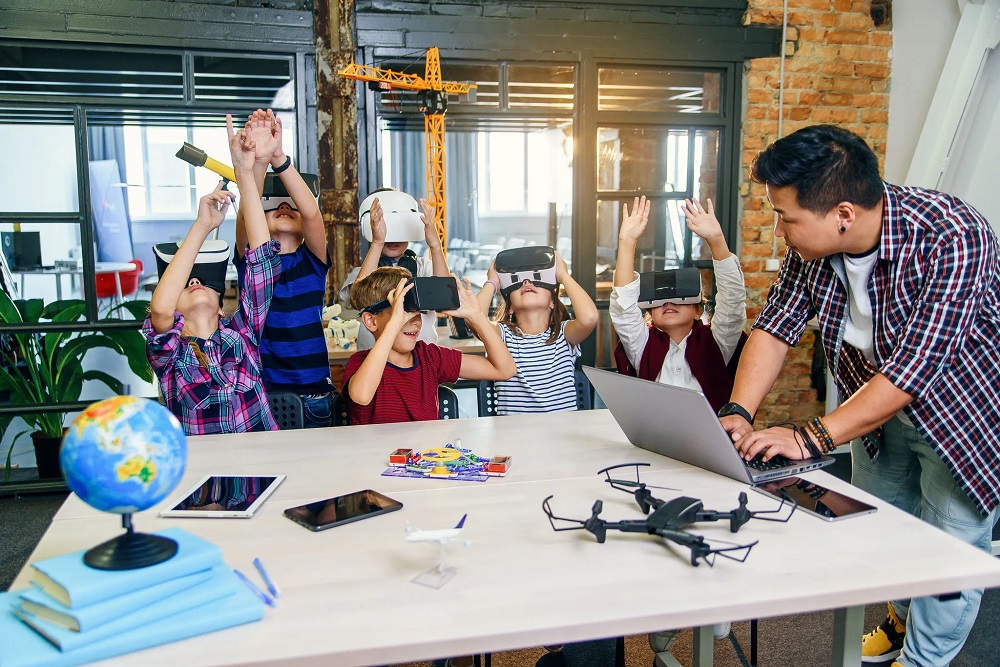
Abstract concepts in science, technology, engineering, art, and mathematics can be exceptionally challenging for students to grasp through static textbooks or oral lectures alone. Immersive learning technologies—including Virtual Reality (VR) and Augmented Reality (AR)—transform passive observation into active, experiential discovery.
Immersive digital environments offer profound pedagogical benefits across diverse subjects:
-
Virtual Medical and Engineering Labs: Science students can perform complex organ dissections, chemical experiments, or structural engineering tests in safe, low-risk digital environments without expensive lab equipment or chemical hazards.
-
Historical and Cultural Exploration: History and humanities classes can step back in time to explore ancient Roman architecture, examine digital replicas of historical artifacts, or walk through global museums virtually.
-
Spatial Visualization in Mathematics: Advanced geometry and physics students can manipulate complex three-dimensional vectors, molecules, and mechanical designs in real time, enhancing spatial comprehension.
Experiential learning through immersive simulations significantly increases student engagement, deepens conceptual understanding, and improves long-term memory retention.
Reimagining Curricula: From Rote Memorization to Skill Mastery
In an age where global knowledge is instantly accessible via handheld devices, the academic value of memorizing isolated facts has dropped precipitously. Future-ready educational models shift focus away from passive information absorption toward mastering higher-order cognitive skills and practical competencies.
Modern innovative curricula emphasize interdisciplinary project-based learning frameworks:
-
Critical Thinking and Complex Problem-Solving: Students work collaboratively to address real-world challenges—such as urban sustainability, renewable energy design, or community public health—requiring cross-disciplinary research and analytical reasoning.
-
Digital Literacy and Computational Thinking: Curricula integrate coding, algorithm evaluation, data analysis, and ethical artificial intelligence usage across all grade levels, preparing students for digital workforce environments.
-
Social-Emotional Learning (SEL): Explicit instruction in emotional regulation, empathy, cross-cultural communication, and teamwork builds the psychological resilience required to navigate changing career landscapes.
-
Agile Project Management: Students learn to break complex tasks into actionable goals, manage timelines, iterate based on feedback, and present professional solutions to external community panels.
Reorienting educational metrics around practical skill mastery ensures graduates enter post-secondary education and professional industries as confident, self-directed learners.
Modernizing Assessment Models and Credentials
Traditional academic assessment relies heavily on high-stakes, summative examinations administered at the end of a semester. These snapshot tests often evaluate short-term memorization skills rather than authentic understanding, creating unnecessary academic anxiety while offering limited feedback for continuous improvement.
Innovative education models replace rigid testing structures with continuous, formative assessment systems and micro-credentials:
-
Digital Learning Portfolios: Students curate ongoing digital collections of original projects, coding repositories, research essays, and creative media, providing a comprehensive, authentic record of growth over time.
-
Micro-Credentials and Digital Badges: Institutions break broad academic disciplines down into verifiable skill badges, allowing learners to demonstrate mastery in specific software tools, laboratory techniques, or professional competencies.
-
Continuous Feedback Loops: Digital assessment tools provide immediate, constructive feedback on daily assignments, allowing students to revise work, correct misunderstandings, and learn directly from mistakes in real time.
Modernizing assessment practices aligns academic evaluation with real-world professional environments, where project portfolios and demonstrated competency hold far greater value than isolated test scores.
Democratizing Access Through Flexible Hybrid Models
Geographic location, socioeconomic status, and physical mobility limitations have historically constrained access to high-quality educational resources. Innovative digital infrastructure and flexible hybrid learning models break down traditional institutional barriers, expanding educational access globally.
Hybrid learning frameworks offer versatile delivery channels:
-
Blended Classroom Structures: Combining interactive online modules for home study with active, collaborative in-person classroom sessions optimizes physical instructional time.
-
Global Collaborative Classrooms: Video conferencing and collaborative digital workspaces connect students across different countries, enabling cross-cultural team projects and global perspective sharing.
-
Lifelong Learning Platforms: Flexible modular courses allow working adults to upskill, pivot careers, or pursue personal intellectual enrichment at any stage of life, dismantling the myth that education ends with a university degree.
Democratizing high-quality educational resources helps level the socioeconomic playing field, empowering diverse global communities through lifelong learning opportunities.
Frequently Asked Questions
What is the biggest barrier to implementing educational innovation in public schools?
The primary barriers include inadequate funding for technology infrastructure, rigid regulatory frameworks, standardized testing mandates, and a lack of continuous professional development for educators. Successfully adopting innovation requires investing heavily in teacher training, updating school facilities, and reforming policy guidelines alongside purchasing new hardware or software.
Will artificial intelligence replace human teachers in future classrooms?
No, artificial intelligence will not replace human teachers. While AI can personalize learning exercises, automate grading, and identify learning gaps efficiently, it cannot replace human empathy, mentorship, emotional encouragement, ethical guidance, and classroom community building. AI serves as a powerful assistant that frees teachers to focus on meaningful student mentorship.
What is project-based learning, and how does it differ from traditional instruction?
Project-based learning is a teaching method where students acquire knowledge and skills by working over an extended period to investigate and respond to an authentic, complex, and engaging real-world challenge. Unlike traditional instruction, which relies on teacher lectures and isolated textbook exercises, project-based learning emphasizes interdisciplinary research, teamwork, creative problem-solving, and public portfolio presentations.
How does innovative education address learning needs for students with disabilities?
Innovative technology enhances accessibility through adaptive interfaces, text-to-speech tools, automated real-time captioning, customizable visual displays, and screen readers. Additionally, personalized learning platforms allow students with cognitive or physical disabilities to engage with academic content in ways tailored to their unique sensory, physical, and cognitive requirements.
Why is social-emotional learning considered a critical component of future education?
Social-emotional learning builds self-awareness, emotional management, empathy, relationship skills, and responsible decision-making. In a rapidly changing, technology-driven world, technical skills can become obsolete quickly, but strong emotional intelligence, resilience, and adaptability remain lifelong essential capabilities for personal success and professional collaboration.
How can parents support innovative learning habits at home?
Parents can support innovative learning by encouraging curiosity, asking open-ended questions, supporting problem-solving rather than supplying immediate answers, and reframing mistakes as natural learning opportunities. Additionally, parents can encourage constructive technology usage, such as coding games, educational simulations, and creative digital media, rather than purely passive screen consumption.
What is the difference between summative and formative assessment?
Summative assessment evaluates student learning at the end of an instructional unit by comparing it against a benchmark, such as a final exam or term paper. Formative assessment monitors student learning continuously during the instructional process, providing ongoing feedback that educators use to adjust teaching strategies and students use to improve their understanding before final evaluations.

Comments are closed.